
If you follow real estate headlines, you’ve probably seen phrases like “The median home price in Lake Oswego is…” But what does that number actually mean—and how useful is the median home price when you’re deciding whether to buy or sell?
Let’s break it down in plain English and then apply it to Lake Oswego, where price ranges and property types can vary dramatically from one neighborhood to the next.
What Is the Median Home Price?
The median home price is the midpoint of all homes sold in a given area during a specific period.
-
Half of the homes sold above this price
-
Half sold below it
That’s it. No weighting. No distortion from outliers.
A Simple Example
If five homes sell for:
-
$900,000
-
$1,050,000
-
$1,200,000 ← median
-
$1,350,000
-
$2,800,000
The median price is $1,200,000, even though one sale is far higher than the rest.
Why Median Price Is More Useful Than Average
In markets like Lake Oswego, the average price can be misleading.
A handful of luxury or waterfront sales can pull the average higher—even if most homes are selling in a narrower, more predictable range.
The median helps because it:
-
Reflects what a typical buyer actually paid
-
Smooths out luxury spikes and one-off sales
-
Tracks real demand shifts more accurately over time
This is why economists, MLS systems, and serious market analysts rely on median pricing when assessing trends.
Median Price in Lake Oswego: Context Matters
Lake Oswego is not a single-price market.
You’ll find:
-
Entry-level homes and condos
-
Trade-up family homes
-
New construction
-
Legacy luxury and lakefront properties
Because of that, the median price acts as a temperature check, not a valuation tool.
How to Read It Correctly
When you see that Lake Oswego’s median price is hovering around (example range):
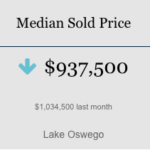
$900,000–$1.1M → steady demand for move-up buyers
Flat or modest growth → balanced inventory and pricing discipline
Sharp jumps → likely driven by sales mix, not across-the-board appreciation
The key question isn’t “What is the median?” It’s “Why did it move?”
What Median Price Does Not Tell You
The median price cannot answer these questions on its own:
-
What your specific home is worth
-
How condition, layout, or lot size affects value
-
Whether buyers are negotiating aggressively
-
How pricing differs between neighborhoods
Two homes can sit on opposite ends of the median and behave very differently in the market.
How Buyers Should Use Median Price Data
For buyers, the median price is a context tool, not a target.
Use it to:
-
Understand where the center of the market sits
-
Gauge competition in your price band
-
Spot shifts in buyer leverage
But your offer strategy should be based on:
-
Comparable sales
-
Days on market
-
Inventory levels
-
Seller motivation
How Sellers Should Use Median Price Data
For sellers, median price is not a pricing shortcut.
It helps you:
-
Understand overall demand health
-
See whether the market is accelerating or cooling
-
Avoid unrealistic expectations driven by headline numbers
Your pricing should be grounded in:
-
Direct neighborhood comps
-
Condition and updates
-
Buyer sensitivity at your price point
The Bottom Line
The median home price tells you how the market is behaving, not what your home is worth.
In Lake Oswego especially, smart decisions come from layering median price trends with local data, neighborhood nuance, and real-time buyer behavior.
That’s where confidence—and leverage—comes from.
What does median home price mean in real estate?
The median home price is the midpoint price of all homes sold, with half selling above and half below that number.
Why is median price better than average price?
Median price isn’t distorted by unusually high or low sales, making it more reliable in markets with wide price ranges.
Does the median price tell me what my home is worth?
No. Median price reflects overall market behavior, not the value of an individual property.
How should buyers use median price data?
As a market context indicator—not a pricing target—alongside comps and inventory trends.
How should sellers interpret median price trends?
As a signal of demand strength and market direction, not a substitute for a property-specific pricing strategy.